






19
Oct
GST Litigation: How to Handle Show-Cause Notices and Appeals
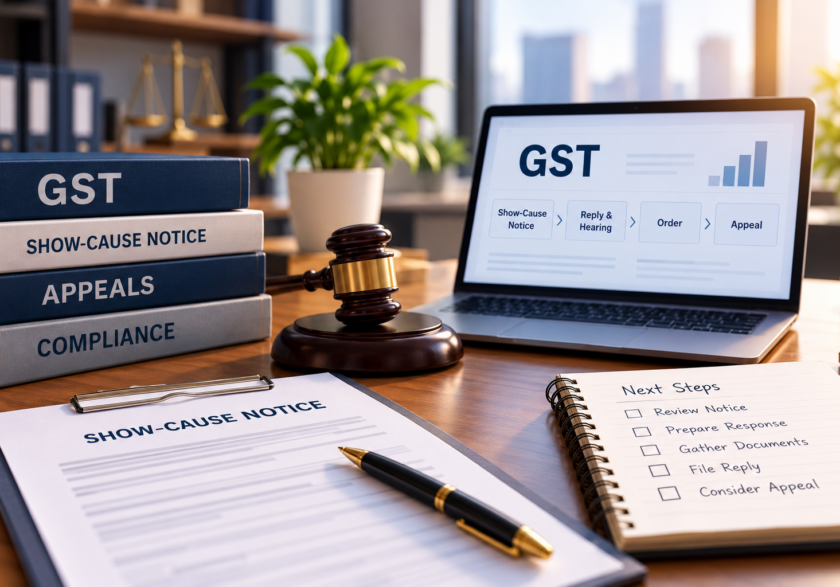
A GST show-cause notice usually arrives months or years after the period it questions. It may allege an input tax credit (ITC) mismatch, short payment of tax, wrong classification or undisclosed turnover, and it comes with a demand for tax, interest and penalty. How the business responds in the first few weeks often shapes everything that follows: whether the matter closes at the adjudication stage, how much penalty applies, and whether a strong appeal remains possible.
This guide explains how a GST show cause notice works under the CGST Act, 2017, how to prepare a reply, what happens at the hearing and order stage, and how the appeal route runs from the Appellate Authority to the GST Appellate Tribunal (GSTAT). The law is stated as of October 2026.
How Should a Business Handle a GST Show-Cause Notice?
Note the reply deadline, identify the section and tax period, and check whether the notice was issued within the time limit. Reconcile the department’s figures with your returns and books, decide whether to pay any admitted amount early to reduce penalty, and file a documented reply in Form GST DRC-06 that addresses every allegation. Attend the personal hearing, and if the final order is adverse, file an appeal within the statutory period with the required pre-deposit.
What Is a GST Show-Cause Notice?
A show-cause notice (SCN) is a formal notice from a GST officer asking a taxpayer to explain why tax, interest and penalty should not be demanded. It is issued in Form GST DRC-01, with a summary uploaded on the GST portal. It is the start of adjudication, not a final demand: no recovery can be made on the basis of the SCN alone, and the taxpayer has a right to reply and be heard.
Before issuing an SCN, the officer may send a pre-SCN intimation in Form GST DRC-01A, giving the taxpayer a chance to pay or explain. This step is currently discretionary, so not every case will have one. Where it is issued, a well-reasoned response at that stage can sometimes prevent the SCN altogether.
Which Section Applies: 73, 74 or 74A?
The section matters because it decides the time limit, the penalty and whether fraud is alleged.
| Provision | Applies to | Nature of case | SCN time limit | Order time limit |
|---|---|---|---|---|
| Section 73 | Periods up to FY 2023-24 | Non-fraud: tax unpaid, short paid, erroneously refunded or ITC wrongly availed or utilised | At least 3 months before the order deadline (2 years 9 months) | 3 years from the due date of the annual return for the year |
| Section 74 | Periods up to FY 2023-24 | Fraud, wilful misstatement or suppression of facts to evade tax | At least 6 months before the order deadline (4 years 6 months) | 5 years from the due date of the annual return |
| Section 74A | FY 2024-25 onwards | Both non-fraud and fraud cases, with different penalties | 42 months from the due date of the annual return | 12 months from the SCN, extendable by up to 6 months |
Swipe the table sideways to see all columns.
For erroneous refunds, the time limits run from the date of the refund rather than the annual return due date. Section 74A was introduced by the Finance (No. 2) Act, 2024 to replace the two-track system for FY 2024-25 onwards with a single timeline. Checking the dates is the first defence: a notice or order issued after the limit can be challenged on that ground alone.
Penalty Under Each Section and How Early Payment Reduces It
The law rewards early payment of tax and interest, which matters when part of the demand is clearly correct.
| When tax and interest are paid | Section 73 (non-fraud) | Section 74 (fraud) | Section 74A non-fraud | Section 74A fraud |
|---|---|---|---|---|
| Before the SCN | No penalty | 15% of tax | No penalty | 15% of tax |
| Within the window after the SCN | No penalty (within 30 days) | 25% of tax (within 30 days) | No penalty (within 60 days) | 25% of tax (within 60 days) |
| Within the window after the order | 10% of tax or ₹10,000, whichever is higher | 50% of tax (within 30 days) | 10% of tax or ₹10,000, whichever is higher | 50% of tax (within 60 days) |
| Later | 10% of tax or ₹10,000, whichever is higher | 100% of tax | 10% of tax or ₹10,000, whichever is higher | 100% of tax |
Swipe the table sideways to see all columns.
Interest under Section 50 is payable in addition to tax in all cases. Paying an admitted portion early does not stop you from contesting the rest. If a notice under Section 74 alleges fraud but the officer cannot establish it, Section 75(2) requires the demand to be recomputed as a non-fraud case.
Common Grounds for GST Show-Cause Notices
- ITC mismatches between GSTR-3B and GSTR-2A/2B, often due to supplier non-filing
- Ineligible or blocked credit under Section 17(5)
- Short payment where GSTR-1 liability exceeds GSTR-3B payment
- Classification or rate disputes for goods or services
- Turnover differences between GST returns, income tax returns, e-way bills or financial statements
- Reverse charge liabilities not discharged
- Place of supply issues affecting IGST versus CGST and SGST
- Erroneous refunds, including export and inverted duty refunds
- Credit from cancelled or non-existent suppliers, which may be treated more seriously
Many of these arise from data-matching on the GST system. A mismatch is a starting point for inquiry; it is not proof that tax is actually due, and the reply is the place to explain the difference.
How to Reply to a GST Show-Cause Notice: Step by Step
- Record the deadline. The notice states the time allowed to reply, commonly 30 days. If you need more time, request it in writing before the deadline and keep proof.
- Read the notice closely. Identify the section, tax period, each allegation, the amounts demanded and the documents relied on. Ask for copies of any relied-upon documents you have not received.
- Check jurisdiction and limitation. Confirm the officer’s authority, that the notice was issued within the time limit for that year, and that the correct section has been invoked.
- Reconcile the numbers. Compare the department’s figures with GSTR-1, GSTR-3B, GSTR-2B, GSTR-9/9C, books of account and e-way bills. Many notices fail on arithmetic or duplication.
- Decide on early payment. Where part of the demand is correct, consider paying that portion with interest within the reduced-penalty window, through Form GST DRC-03, and say so in the reply.
- Prepare the reply. Address every allegation in turn with facts, reconciliations, legal provisions, circulars and relevant judgments. Raise legal objections, such as limitation or lack of jurisdiction, without waiving factual arguments.
- Attach evidence. Include invoices, payment proofs, supplier confirmations, contracts, ledger extracts and reconciliation statements, indexed and referenced in the reply.
- File in Form GST DRC-06 on the portal and keep the acknowledgment. Ask for a personal hearing in the reply.
The reply is also the record an appellate authority will later review. Points not raised at this stage can be harder to argue later, so it is worth being thorough. Our guide on responding to an income tax notice covers the parallel process under the Income-tax Act.
Personal Hearing and the Adjudication Order
Under Section 75(4), an opportunity of hearing must be given where the taxpayer requests it in writing or where an adverse decision is contemplated. Adjournments are allowed for sufficient cause, but no more than three times during the proceedings under Section 75(5). Prepare a short written synopsis for the hearing and file any additional submissions promptly afterwards.
The officer then issues an order in Form GST DRC-07. The order must give reasons, cannot confirm a demand higher than the SCN amount and cannot rely on grounds not stated in the SCN. If the order contains apparent errors, a rectification application under Section 161 may be possible, but it does not extend the appeal deadline, so plan both in parallel.
Appealing a GST Order: The Appellate Route
| Stage | Forum | Form | Time limit | Pre-deposit |
|---|---|---|---|---|
| First appeal (Section 107) | Appellate Authority (Commissioner (Appeals) or equivalent) | GST APL-01 | 3 months from communication of the order, plus up to 1 month for sufficient cause | Admitted amount in full, plus 10% of disputed tax, capped at ₹20 crore each for CGST and SGST |
| Second appeal (Section 112) | GST Appellate Tribunal | GST APL-05 | 3 months from communication of the appellate order, subject to condonation by the Tribunal and any notified transitional dates | Admitted amount in full, plus a further 10% of disputed tax, capped at ₹20 crore each for CGST and SGST |
| Further appeal | High Court (Section 117) and Supreme Court (Section 118) | As per court rules | Generally 180 days for a High Court appeal under Section 117 | As applicable |
Swipe the table sideways to see all columns.
The 10% pre-deposit is calculated on disputed tax only, not on interest or penalty. Once it is paid and the appeal is filed, recovery of the balance is deemed stayed. For appeals against penalty-only orders, a pre-deposit of 10% of the disputed penalty now applies at both the first appeal and Tribunal stages, effective 1 October 2025, with no monetary cap. Integrated tax has its own ceiling, so check the IGST position in mixed cases.
The GST Appellate Tribunal Is Now Functional
For years, second appeals could not be filed because the Tribunal had not been constituted. The GSTAT was launched on 24 September 2025, with a Principal Bench in New Delhi and State Benches across the country, and appeals are filed online on the GSTAT e-filing portal. For orders communicated before 1 April 2026, the Government had set a one-time window for filing appeals; that window was later extended to 31 July 2026 and has now closed. Appeals against later orders follow the normal three-month limit. Delayed appeals depend on the Tribunal’s discretion to condone delay, so they should be treated as exceptional.
Writ Petitions
In some situations, such as a clear violation of natural justice, an order passed without jurisdiction or beyond limitation, a High Court writ petition under Article 226 may be considered. Courts generally expect taxpayers to use the statutory appeal route first, so this is a matter for case-specific legal advice.
Documents to Keep Ready for GST Litigation
- The SCN, DRC-01A (if any), relied-upon documents and all correspondence
- GSTR-1, GSTR-3B, GSTR-2A/2B and GSTR-9/9C for the period
- Books of account, ledgers and trial balance
- Sales and purchase invoices, debit and credit notes
- E-way bills, transport and delivery records
- Bank statements and proof of payment to suppliers
- Contracts, purchase orders and work orders
- Reconciliation statements for every disputed figure
- Earlier replies, hearing records and orders
- DRC-03 challans for any amounts paid
Common Mistakes in Handling GST Notices
| Mistake | Better approach |
|---|---|
| Ignoring portal notices or missing the reply date | Monitor the GST portal and registered email regularly |
| Filing a one-line or generic reply | Answer each allegation with evidence and reconciliation |
| Not checking limitation | Calculate the time limit for each tax period |
| Skipping the personal hearing | Attend with a written synopsis |
| Paying the full demand without review | Pay admitted amounts only, after reconciliation |
| Missing the early-payment penalty window | Decide on partial payment soon after the SCN |
| Letting the appeal period lapse while seeking rectification | Run rectification and appeal timelines in parallel |
| Raising new facts only at the appeal stage | Put all evidence on record during adjudication |
Swipe the table sideways to see all columns.
When to Engage a GST Litigation Professional
Professional support is especially useful when the demand is large, fraud or suppression is alleged, the issue involves classification, place of supply or ITC from cancelled suppliers, several years are under review, or an appeal or Tribunal filing is due. Chartered accountants can act as authorised representatives before GST authorities and the Tribunal under Section 116. A professional can check limitation, reconcile data, draft replies and grounds of appeal, and represent the business at hearings, but cannot guarantee a particular outcome.
AAPT & Associates provides GST litigation services, from SCN replies to appeals, alongside regular GST compliance that reduces the risk of notices in the first place.
Frequently Asked Questions
What is a show-cause notice under GST?
A formal notice in Form GST DRC-01 asking a taxpayer to explain why tax, interest and penalty should not be demanded. It starts adjudication; it is not a final demand.
How many days do I get to reply to a GST SCN?
The notice states the period, commonly 30 days. If you need more time, request an extension in writing before the deadline.
What is the difference between Sections 73, 74 and 74A?
Section 73 covers non-fraud cases and Section 74 covers fraud or suppression for periods up to FY 2023-24. Section 74A covers both for FY 2024-25 onwards, with a single 42-month SCN limit and different penalties.
Can I reduce the penalty by paying early?
Yes. Paying tax and interest before the SCN or within the specified window after it can eliminate or reduce the penalty, depending on the section. You can still contest the remaining demand.
Is a personal hearing mandatory?
An opportunity of hearing must be given where the taxpayer asks for it in writing or where an adverse decision is contemplated. Always request one in your reply.
What is the time limit to file a GST appeal?
Three months from communication of the order for a first appeal, with up to one further month for sufficient cause. A Tribunal appeal is also generally due within three months of the appellate order.
How much pre-deposit is required for a GST appeal?
The admitted amount plus 10% of disputed tax for a first appeal, and a further 10% for a Tribunal appeal, each capped at ₹20 crore for CGST and SGST. Penalty-only appeals need 10% of the disputed penalty.
Is the GST Appellate Tribunal working now?
Yes. The GSTAT was launched in September 2025 and accepts appeals online. The special filing window for older orders ended on 31 July 2026; newer orders follow the normal three-month limit.
Can the department recover the demand while my appeal is pending?
Once the required pre-deposit is paid and the appeal is filed, recovery of the remaining disputed amount is deemed stayed.
Can a chartered accountant represent me in GST litigation?
Yes. Under Section 116, a practising chartered accountant can act as an authorised representative before GST authorities and the Appellate Tribunal.
Respond Early, Document Everything
Most GST disputes are won or lost on the quality of the record: accurate reconciliations, a complete reply and evidence filed at the adjudication stage. Check limitation first, use early payment where part of the demand is valid, and keep the appeal timeline in view from the day the order arrives.
This article provides general information as of October 2026 and is not legal or tax advice for any specific case. GST law and procedures change frequently; confirm the current position before acting.
Received a GST Notice?
AAPT & Associates helps businesses reply to GST show-cause notices and file appeals before the Appellate Authority and the GST Appellate Tribunal.
Official sources: CBIC GST (Acts, Rules, Notifications) · GST Portal · GSTAT e-Filing Portal