






25
Sep
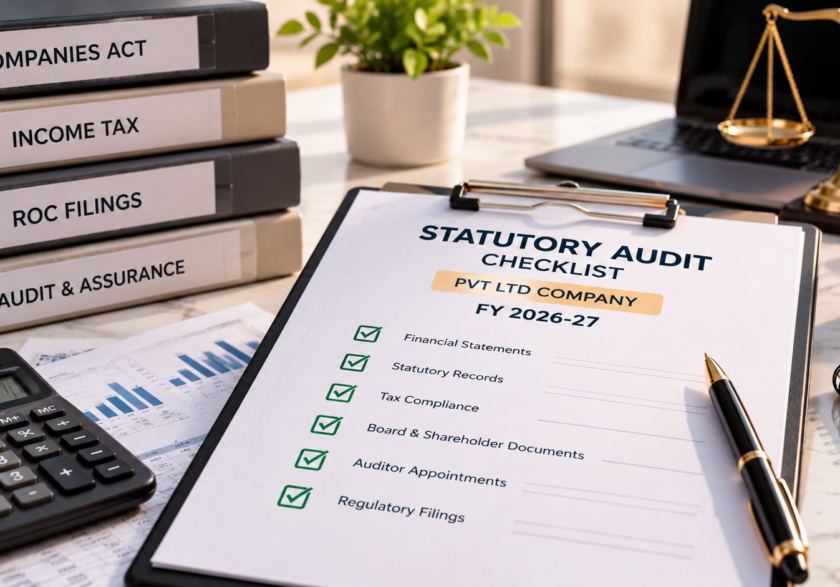
Statutory Audit Checklist for Pvt Ltd Companies FY 2026-27
Every private limited company in India must have its financial statements audited by an independent Chartered Accountant every year, regardless of its size or turnover. This statutory audit checklist for private limited companies covers the documents, reconciliations and approvals your team should prepare for the financial year 1 April 2026 to 31 March 2027, along with the key Companies Act provisions and ROC due dates that follow the audit.
Quick Answer
To prepare for a statutory audit for FY 2026-27, a private limited company should close and reconcile its books as on 31 March 2027, reconcile bank, GST, TDS and payroll records, update the fixed asset and inventory records, document related-party transactions and approvals, and prepare draft financial statements in the Schedule III format. The Board must approve the financial statements before the auditor signs the report, and the AGM must generally be held by 30 September 2027.
Good preparation shortens fieldwork, reduces back-and-forth queries and helps finalise accounts on time. Requirements vary with company classification, exemptions, industry-specific laws and the latest notifications, so treat this as a general compliance guide, not a substitute for advice from your statutory auditor, company secretary or legal adviser. The checklist also does not replace the auditor’s independent judgement on what evidence is needed.
Is a Statutory Audit Mandatory for Private Limited Companies in India?
Yes. Under Section 139 of the Companies Act, 2013, every company must appoint an auditor, and under Section 143 the auditor reports to the members on whether the financial statements give a true and fair view. There is no exemption for low turnover, small size or no business activity. A company with nil revenue still needs audited financial statements.
It helps to separate four different audits:
- Statutory audit (Companies Act): mandatory for every company.
- Tax audit (income-tax law): required only when turnover or other prescribed thresholds are crossed. From 1 April 2026, the Income-tax Act, 2025 has replaced the 1961 Act, and the tax audit provision formerly in Section 44AB now sits in Section 63 of the new Act.
- Internal audit (Section 138): mandatory only for prescribed classes of companies based on turnover and borrowing thresholds. Many others choose one voluntarily. Read more about internal audit services.
- Secretarial audit (Section 204): applies to listed companies and prescribed classes of larger companies, not to most private companies.
Additional requirements, such as CARO 2020 reporting or internal financial controls reporting, depend on thresholds and exemptions covered below.
Key Statutory Audit Requirements for FY 2026-27
| Compliance area | Provision | What the company should verify |
|---|---|---|
| Appointment of auditor | Sections 139 and 141 | Auditor validly appointed for the five-year term, eligible and not disqualified, and appointment filed with the ROC |
| Auditor’s powers and duties | Section 143 | Auditor has access to all books, vouchers and records, and management can provide information and explanations |
| Auditor independence | Section 144 | Auditor is not also providing prohibited services such as accounting and bookkeeping, internal audit or management services to the company |
| Financial statements | Sections 129 and 133 | Statements follow Schedule III and the notified Accounting Standards or Ind AS, as applicable |
| Board approval and signing | Section 134 | Board approves the financial statements before they go to the auditor for the report; correct signatories |
| Books of account | Section 128 | Books kept on accrual and double-entry basis, preserved for eight years, with audit trail enabled in the accounting software |
| Auditor reporting | Section 143(3), Rule 11, CARO 2020 | Supporting data ready for matters the auditor must report on, where applicable |
| Filing financial statements | Section 137 | Form AOC-4 filed within 30 days of the AGM |
Swipe the table sideways to see all columns.
Two points are easy to miss. First, under Rule 3 of the Companies (Accounts) Rules, 2014, companies using accounting software must use software that records an audit trail (edit log) of every transaction, which cannot be disabled. The auditor reports on this under Rule 11(g) of the Companies (Audit and Auditors) Rules, 2014. Second, Section 144 means the firm that keeps your books cannot also be your statutory auditor.
Complete Statutory Audit Preparation Checklist
Use this as a working checklist before handing records to your auditor. Not every item applies to every company.
1. Corporate and Statutory Documents
- Certificate of Incorporation, MoA and AoA (current versions)
- PAN, TAN, GST and other applicable registrations
- Previous year’s audited financial statements and auditor’s report
- Previous year’s AOC-4 and MGT-7/MGT-7A filing acknowledgements
- Board and general meeting minutes relevant to financial matters
- Register of members and shareholding details
- Register of directors and KMP, where applicable
- Changes during the year in directors, share capital, registered office or ownership
- Auditor’s appointment resolution and ADT-1 filing
Why it matters: these confirm the company’s legal structure, governance and which reporting requirements apply.
2. Books of Account and Financial Records
- General ledger and trial balance for FY 2026-27
- Sales and purchase registers
- Journal vouchers and adjustment entries, with support
- Cash book and petty cash records
- Bank books and bank statements
- Fixed asset register
- Inventory records, where applicable
- Receivable and payable ledgers
- Loans, advances, deposits and borrowings schedules
- FY 2025-26 closing balances agreed to FY 2026-27 opening balances
Section 128 requires books on accrual basis and double-entry system. Well-kept accounting and bookkeeping is the foundation of a smooth audit.
3. Bank, Cash and Reconciliation
- Bank statements for all accounts as on 31 March 2027
- Bank reconciliation statement for every account
- Payment gateway and merchant account reconciliations
- List of outstanding cheques and deposits in transit
- Support for unusual or significant transactions
- Cash balance confirmation and physical count, where relevant
Investigate and document unexplained differences. Do not pass adjustment entries simply to make balances agree.
4. Revenue, Expenses and Supporting Documents
- Sales invoices and credit notes
- Purchase invoices and debit notes
- Major customer and vendor contracts
- Expense bills and vouchers
- Advances received and paid
- Revenue recognition workings
- Cut-off support for transactions around 31 March 2027
- Documentation for material or unusual transactions
Check that all revenue is recorded, expenses are correctly classified, and year-end transactions fall in the right period.
5. GST, TDS and Other Statutory Dues
- GST returns reconciled with the books
- GSTR-1 vs GSTR-3B vs books, and GSTR-2B vs input tax credit claimed
- TDS/TCS returns, and TDS payable and receivable (Form 26AS/AIS) reconciliations
- Challans and payment proofs
- PF, ESI, professional tax and other applicable dues
- Outstanding demands, notices, disputes and appeals
Applicability depends on your registrations, activities, employee count and thresholds. For support, see our GST services.
6. Payroll and Employee Records
- Payroll registers and salary expense schedules
- Reimbursement records
- Bonus, leave encashment and gratuity workings, where applicable
- PF and ESI contribution records, where applicable
- Employee advances and loans
- Director remuneration and approvals
- Payroll reconciled with statutory filings and the books
7. Fixed Assets and Depreciation
- Updated fixed asset register
- Invoices for additions and documents for disposals
- Physical verification records, where applicable
- Depreciation under Schedule II of the Companies Act (book depreciation)
- Reconciliation with tax depreciation, where relevant
- Capital work-in-progress support
Book depreciation follows Schedule II and accounting standards. Tax depreciation follows income-tax rules. The two usually differ.
8. Loans, Borrowings and Related-Party Transactions
- Loan agreements, lender statements and balance confirmations
- Repayment schedules and interest workings
- Charge creation and satisfaction records, where applicable
- Loans, guarantees and advances involving directors or related parties
- Related-party list, transactions and disclosures
- Board and shareholder approvals, where required
- Related-party balance confirmations
Review Sections 185, 186 and 188 and the related-party disclosure requirements of the applicable accounting standard. Many related-party transactions are permitted with the right approvals; the point is to document them.
9. Inventory and Work-in-Progress
- Inventory listing as on 31 March 2027
- Physical stock count sheets
- Physical vs book quantity reconciliation
- Valuation method and workings
- Slow-moving, damaged or obsolete stock review
- WIP and cost allocation workings
Relevant only to businesses holding inventory; requirements depend on the business model and accounting standards.
10. Financial Statements and Closing Adjustments
- Draft Balance Sheet and Statement of Profit and Loss
- Cash Flow Statement, where applicable
- Statement of Changes in Equity, where applicable
- Notes to accounts and accounting policies
- Provisions, accruals and outstanding income
- Contingent liabilities and commitments
- Subsequent events and going concern assessment
- Financial statements reconciled with the final trial balance
Financial statements must follow Schedule III. Under Section 2(40), a cash flow statement is not required for one person companies, small companies, dormant companies and private companies that are start-ups. From 1 December 2025, a small company is one with paid-up capital up to ₹10 crore and turnover up to ₹100 crore, excluding certain categories such as holding and subsidiary companies. Confirm your classification with your auditor.
11. CARO 2020 and Other Auditor Reporting
The Companies (Auditor’s Report) Order, 2020 does not apply to one person companies, small companies, Section 8 companies, banking and insurance companies, or to a private company that is not a holding or subsidiary of a public company and meets all three of these conditions: paid-up capital plus reserves not more than ₹1 crore, borrowings from banks or financial institutions not more than ₹1 crore at any time in the year, and total revenue not more than ₹10 crore.
Where CARO applies, keep supporting records ready for:
- Property, plant and equipment and intangible assets
- Inventory and working capital limits
- Loans, guarantees and advances
- Statutory dues
- Borrowings and any defaults
- Fraud and whistle-blower complaints
- Related-party transactions and internal audit
- Cash losses and other applicable clauses
CARO reporting is the auditor’s responsibility. Management’s role is to provide accurate information and documents. Separately, reporting on internal financial controls under Section 143(3)(i) is exempt for certain private companies with turnover below ₹50 crore and borrowings below ₹25 crore. Strengthening internal financial controls helps either way.
12. Management Representations and Auditor Coordination
- Tracker of open audit queries
- Support for significant estimates
- Litigation and claims details
- Related-party declarations
- Information on any fraud or suspected fraud
- Subsequent events and commitments
- Management representation letter, as requested by the auditor
- Access to books, records and relevant staff
Representations support, but do not replace, sufficient appropriate audit evidence.
Statutory Auditor Appointment and ADT-1 Compliance
- First auditor (Section 139(6)): the Board appoints the first auditor within 30 days of incorporation. If it does not, members appoint one within 90 days at an extraordinary general meeting. The first auditor holds office until the first AGM.
- Subsequent auditor (Section 139(1)): appointed at an AGM for a term from that AGM to the sixth AGM. Mandatory rotation under Section 139(2) applies only to prescribed classes, which for private companies means those with paid-up capital or public borrowings of ₹50 crore or more.
- Eligibility (Section 141): confirm the auditor is not disqualified, for example through prohibited relationships, indebtedness or exceeding the limit on number of company audits.
- Form ADT-1: for an appointment at an AGM, the company must file ADT-1 with the Registrar within 15 days of the meeting. Practice on filing ADT-1 for a first auditor appointed by the Board varies, so confirm with your company secretary.
Our company secretarial services team can help with appointments and ROC filings.
Important Statutory Audit and ROC Due Dates for FY 2026-27
| Compliance event | Provision / form | Deadline or calculation | Qualification |
|---|---|---|---|
| Financial year-end | Section 2(41) | 31 March 2027 | Fixed |
| Board approval of financial statements | Section 134 | Before the auditor signs and before the AGM notice | No fixed date; plan to allow AGM notice period |
| Annual General Meeting | Section 96 | Within six months of year-end, so by 30 September 2027 | First AGM within nine months; ROC may grant extension (not for first AGM) |
| Filing financial statements | Section 137, AOC-4 | Within 30 days of the AGM (30 October 2027 if AGM is on 30 September) | Calculated from the actual AGM date |
| Annual return | Section 92, MGT-7 / MGT-7A | Within 60 days of the AGM (29 November 2027 if AGM is on 30 September) | MGT-7A applies to small companies and OPCs |
| Tax audit report | Section 63, Income-tax Act 2025 | Generally 30 September 2027 for tax year 2026-27 | Only if thresholds apply; confirm against CBDT notifications |
| Income-tax return | Income-tax Act 2025 | Company due date as notified for tax year 2026-27 | Verify on the Income Tax portal before relying on any date |
Swipe the table sideways to see all columns.
The AGM, AOC-4 and MGT-7 dates are calculated from the Companies Act. Tax dates may be changed or extended by the government, and no extension should be assumed in advance.
Common Mistakes Companies Should Avoid
- Starting before bank reconciliations are done. Everything downstream depends on reconciled bank balances; skipping this creates rework.
- Incomplete or inconsistent records. Mismatched schedules generate more queries and extend fieldwork.
- Ignoring old balances. Stale receivables, payables and suspense balances often need write-offs, provisions or explanations.
- Unreconciled GST and TDS. Differences between returns and books surface during the audit and may need disclosure or correction.
- Missing related-party approvals and disclosures. These are commonly reviewed and harder to fix after the year-end.
- Treating statutory and tax audits as the same. They are separate engagements under different laws, with different reports and timelines.
- Unsupported year-end entries. Large adjustments without documentation reduce the reliability of the financial statements.
- Slow responses to auditor queries. Delays compress the time left before the AGM and filing deadlines.
None of these automatically leads to a penalty or a modified audit opinion, but each can delay the audit or weaken the financial statements.
Frequently Asked Questions
Is statutory audit mandatory for every private limited company in India?
Yes. Section 139 of the Companies Act, 2013 requires every company to appoint an auditor, and its financial statements must be audited each year. There is no turnover-based exemption, so even a company with little or no business activity needs a statutory audit.
What documents are required for a private limited company statutory audit?
Typically the trial balance and ledgers, bank statements and reconciliations, sales and purchase records, GST and TDS returns, payroll records, fixed asset and inventory records, loan and related-party documents, minutes and registers, the previous year’s audited accounts, and draft financial statements. Your auditor may request more.
What is the statutory audit due date for FY 2026-27?
The Companies Act does not set a separate audit date, but the audit must be completed before the AGM, which must generally be held by 30 September 2027. Financial statements are then filed in AOC-4 within 30 days of the AGM. Tax audit deadlines are separate and subject to notifications.
Is CARO 2020 applicable to all private limited companies?
No. It does not apply to small companies, OPCs, and private companies that are not holding or subsidiary companies of a public company and meet all three limits on capital plus reserves, borrowings and revenue. Other private companies are generally covered, subject to the Order’s terms.
What is the difference between a statutory audit and a tax audit?
A statutory audit under the Companies Act reports on whether financial statements give a true and fair view, and applies to every company. A tax audit under the Income-tax Act, 2025 (Section 63, formerly Section 44AB) applies only above prescribed thresholds and reports on tax-related particulars.
Who appoints the statutory auditor of a private limited company?
The Board appoints the first auditor within 30 days of incorporation, failing which the members do so. Subsequent auditors are appointed by the shareholders at the AGM for a five-year term, usually on the recommendation of the Board.
Is Form ADT-1 mandatory for auditor appointment?
For an auditor appointed at an AGM, the company must file ADT-1 with the Registrar within 15 days of the meeting. Practice for first auditors appointed by the Board varies, so confirm the filing position with your company secretary.
What happens if a company does not complete its statutory audit on time?
It may be unable to hold the AGM and file AOC-4 and MGT-7 on time, which attracts additional fees and possible penalties. Continued failure to file financial statements or annual returns for three consecutive years can lead to disqualification of directors under Section 164(2).
Does a small private limited company need a cash flow statement?
No. Under Section 2(40), financial statements of small companies, OPCs, dormant companies and private company start-ups need not include a cash flow statement. Confirm your company still meets the small company definition for the year.
What should a company prepare before its auditor begins fieldwork?
A closed and reconciled trial balance, bank and statutory dues reconciliations, fixed asset and inventory records, related-party details, supporting schedules for major balances, draft financial statements, and a person assigned to answer queries.
Start Your FY 2026-27 Audit Preparation Early
A smooth statutory audit comes from accurate books, reconciled bank and statutory records, organised supporting documents and prompt coordination with your auditor. Start preparing well before 31 March 2027, keep this checklist updated through the year, and close each quarter’s reconciliations as you go rather than leaving everything for year-end.
This article is a general compliance guide and not legal or professional advice. Requirements depend on your company’s classification and the law and notifications in force at the time.
Get Audit-Ready for FY 2026-27
AAPT & Associates provides statutory audit services for private limited companies across India. Speak to our Chartered Accountants about your company’s audit readiness.